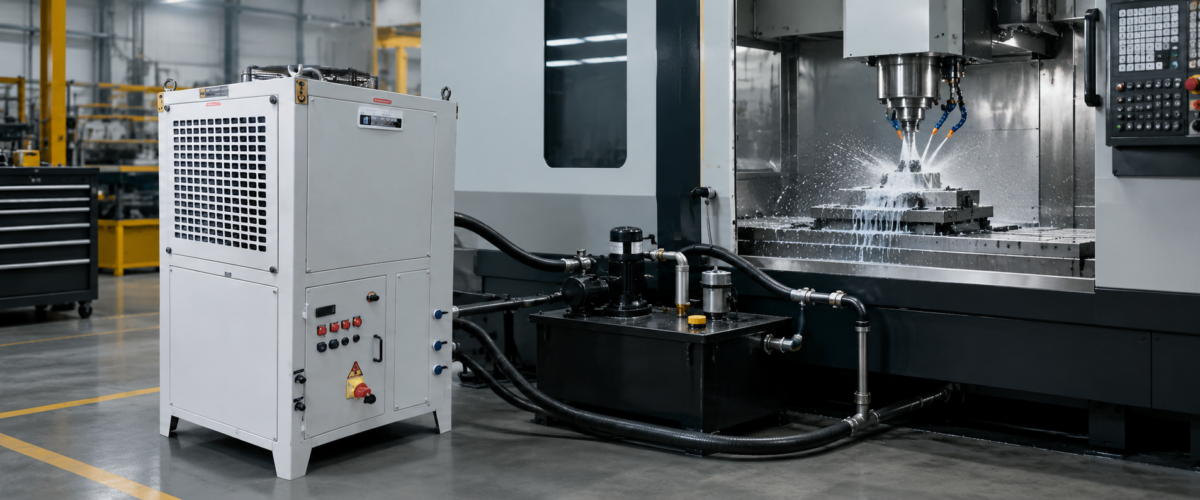
Coolant performs several important functions during CNC machining and grinding. It removes heat from the cutting zone, supports lubrication, and carries chips or grinding particles away from the process. However, coolant itself absorbs heat during machining. Heat generated by cutting, grinding, pumps, spindles, and surrounding plant conditions can gradually increase coolant temperature. For precision manufacturing, controlling this temperature can be just as important as filtering the coolant.
Why Does Coolant Temperature Matter?
Machine tools contain components made from different materials that expand or contract as temperature changes. When coolant temperature fluctuates significantly during production, the machine, cutting tool, and workpiece can experience different thermal conditions.
In precision applications, this can affect:
- Dimensional consistency.
- Process stability.
- Grinding accuracy.
- Surface finish.
- Tool performance.
- Coolant condition.
Maintaining controlled coolant conditions becomes particularly important in long production cycles and close-tolerance machining.
Is There One Ideal Coolant Temperature?
No single coolant temperature is suitable for every CNC machine or grinding application.
The required temperature depends on factors such as:
- Machine-tool design.
- Material being machined.
- Machining process.
- Grinding or cutting parameters.
- Coolant type.
- Required tolerance.
- Ambient shop-floor temperature.
- Heat generated by pumps and equipment.
- Machine manufacturer recommendations.
For this reason, selecting an arbitrary fixed temperature without studying the application can create unnecessary cooling load or unsuitable operating conditions.
Consider the Machine and Process First
A grinding operation producing precision components may require tighter temperature stability than a general machining application. Similarly, high-speed machining, deep-hole drilling or continuous production can introduce different heat loads. The first step should therefore be understanding where heat is being generated and how much heat is transferred into the coolant.
Consider Ambient Temperature
The temperature inside a manufacturing facility can change during the day or across seasons. If coolant conditions move significantly away from the thermal condition of the machine and surrounding environment, temperature differences may influence machine stability. Some applications therefore control coolant relative to ambient conditions, while others require a specified fixed temperature. The correct approach depends on the machine and process requirements.
Evaluate Coolant Type
CNC machining may use water-based emulsions or oil-based coolants. Different fluids have different thermal characteristics, viscosities, and operating requirements. The coolant chiller must therefore be designed for the actual medium being circulated rather than selected only according to machine capacity. Temperature Stability Matters. For precision manufacturing, maintaining a stable coolant condition throughout production is often more important than simply achieving the lowest possible temperature. Repeated temperature fluctuations can continuously change the thermal conditions around the machine and workpiece. A properly selected coolant chiller removes the heat entering the coolant and maintains the required operating temperature during machining.
CNC Machining Applications
Coolant-temperature control can be useful in operations including:
- CNC milling.
- Turning.
- Grinding.
- Gear machining.
- Gun drilling.
- High-speed machining.
- Precision component manufacturing.
The required cooling capacity will vary according to coolant flow, heat generation, and production duty.
Combine Temperature Control with Coolant Filtration
Temperature is only one part of coolant management. Grinding and machining processes also generate chips, fines, and sludge. If coolant cleanliness is critical to the process, filtration and temperature control should be evaluated together. A correctly designed system can therefore combine coolant filtration with chilling to maintain both coolant cleanliness and controlled temperature conditions.
Before selecting a coolant chiller, provide the manufacturer with:
- Coolant type.
- Coolant volume.
- Flow rate.
- Current operating temperature.
- Required temperature.
- Machine type.
- Process details.
- Operating hours.
- Ambient conditions.
- Number of machines to be cooled.
This information helps determine the required cooling capacity and suitable system configuration.
Coolant Temperature Control Solutions from Lex Technoaid
Lex Technoaid provides Coolant Chillers for oil-based and emulsion coolants used in machining applications, including CNC machining and grinding. Depending on the requirement, cooling can be configured for individual machines or multiple-machine applications. Lex also provides Hydraulic Oil Chillers and Water Chillers for other industrial cooling requirements. Chiller capacities are available from 0.3 to 100 tons, depending on the chiller type and application. Need to determine the right coolant-temperature control solution for your CNC or grinding process?
Contact marketing@lextechnoaid.com or call +91 99166 98105 to discuss your machine and cooling requirements.