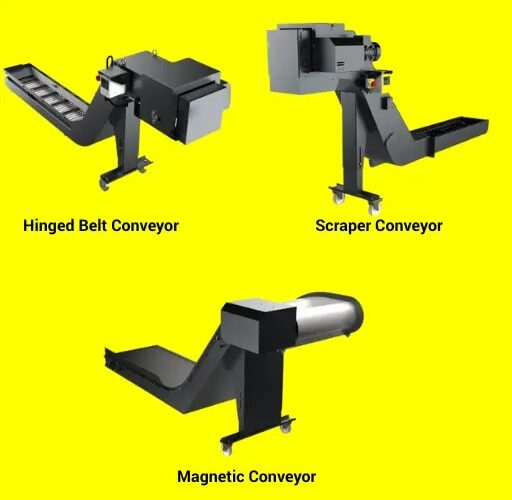
In modern machining environments, chip accumulation is not just a maintenance issue. It directly impacts machine uptime, tool life and overall process efficiency. Whether you operate a compact CNC lathe or manage a full-scale production floor, efficient chip management is essential for maintaining consistent productivity. This is where a well-engineered Chip Conveyor plays a critical role.
An appropriate conveyor system does more than just remove chips. It ensures cleaner coolant, reduces unplanned maintenance and contributes to smoother operations. With several configurations available such as Hinged Belt Conveyor, Scraper Type Conveyor, Magnetic Conveyor and Double Deck Conveyors, selecting the right one requires a clear understanding of your application and material characteristics.
Why CNC Machines Require Dedicated Chip Conveyors
Different machining processes generate different types of metal chips. These range from long, curly swarf produced in turning, to fine powder generated during grinding or gear shaving. If not managed properly, these chips can lead to tool breakage, clogged coolant lines and downtime.
Installing a suitable Chip Conveyor helps address these issues while also maintaining a safer and more efficient work environment.
Hinged Belt Conveyors: Best for General-Purpose Machining
Recommended for: Turning, milling and drilling operations
Chip types handled: Long, curly or bushy chips
Key benefits: Hinged Belt Conveyors use steel belt segments to transport chips efficiently. They are available in different belt styles such as plain, perforated or dimpled to suit the specific chip behavior and coolant flow.
This type of conveyor is commonly used in CNC machining centers handling ferrous and non-ferrous materials, where chip shape is relatively consistent.
Scraper Type Chip Conveyors: Effective for Short or Powdery Chips
Recommended for: Gear shaving, gun drilling and small-part milling
Chip types handled: Short, broken or powdery chips
Key benefits: Scraper Conveyors use steel blades to push chips along the conveyor bed. These are ideal when chips are too small or fragmented to be effectively moved by hinged belts.
Optional magnetic decks can be added to improve chip retention and coolant purity, especially in operations that produce a high volume of fine debris.
Recommended for: Broaching, gear shaping and ferrous part machining
Chip types handled: Powdery, short and broken ferrous chips
Key benefits: Magnetic Chip Conveyors incorporate strong magnetic fields below a stainless-steel surface to attract and carry ferrous chips. They eliminate mechanical parts above the belt surface, which reduces the risk of jamming.
Magnetic Conveyors with close to 90 degree inclination can be designed to discharge chips vertically, allowing better space utilization and minimal coolant loss. These systems are particularly useful in applications that produce fine ferrous chips and require reliable separation from coolant.
Recommended for: Mixed operations involving both short and long chips
Chip types handled:All types : Long, short, coiled and powdery chips
Key benefits: Double Deck Conveyors integrate both hinged belt and scraper functions. This makes them ideal for high-mix environments where chip types vary in a machine.
They are especially valuable in industries such as automotive or aerospace, where a machine may perform a variety of operations.
How to Decide Which Conveyor to Use
Before choosing a conveyor, assess the following:
- Material type: Ferrous materials require Magnetic Conveyors for effective chip retention.
- Chip size and shape: Choose scraper conveyors for fine or broken chips.
- Coolant requirements: Select models with integrated filtration if clean coolant is a priority.
- Shop floor space: Use inclined or compact designs to fit limited spaces.
- Production volume: Higher chip output requires high-capacity conveyors with minimal downtime.
Conclusion
Choosing the right Chip Conveyor is key to maintaining productivity and machine health in CNC operations. Lex Technoaid provides customized conveyor solutions including Hinged Belt, Scraper, Magnetic and Double Deck models. Each system is designed to match specific machining needs and chip types.
Explore how Lex Technoaid can support your operations with the right chip management, coolant filtration and temperature control systems.
Visit www.lextechnoaid.com or contact us at +91 99166 98105 to speak with our team.