CNC machining generates chips in different sizes, shapes, and materials. These chips need to be removed continuously from the machining area to support coolant circulation and reduce manual chip handling. A Chip Conveyor provides an automated method of transporting chips away from the machine. However, different machining processes produce very different chips. Selecting the right conveyor therefore starts with understanding the material, chip shape, chip quantity, and coolant conditions.
Why Does Chip Type Matter?
Turning can generate long and curled chips while milling may produce shorter broken chips. Other machining processes can generate fine or powdery particles. A conveyor suited to long chips may not perform in the same way when handling fine particles.
Important characteristics include:
- Chip length.
- Chip shape.
- Ferrous or non-ferrous material.
- Chip volume.
- Coolant carried with the chips.
- Required discharge arrangement.
These parameters help determine the appropriate conveyor design.
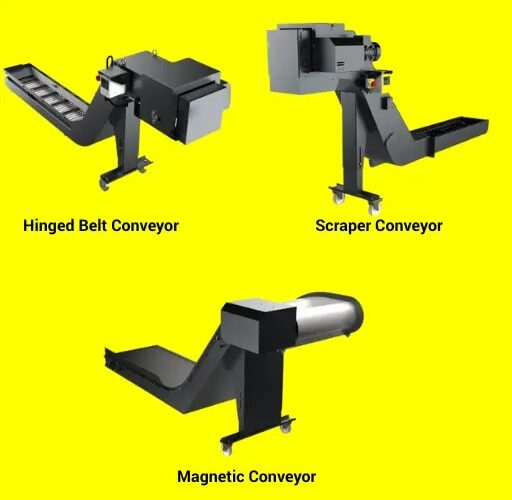
A hinged belt chip conveyor uses a continuous metal belt to transport chips from the machine to a collection point. This type of conveyor is commonly considered for applications generating larger, longer or curled chips. The conveyor configuration needs to consider chip volume, belt width, machine layout, discharge height, and coolant drainage. Hinged conveyors can be integrated with different machine configurations depending on the space available around the equipment.
Scraper Type Chip Conveyors use scraper elements to move chips through the conveyor. They are suitable for handling short, broken, and powdery chips generated by machining processes such as gear shaving, gun drilling, and milling. For ferrous-chip applications, a magnetic deck can also be provided as an option to reduce chips escaping from the conveyor. The required scraper width and conveyor capacity should be selected according to the chip-generation rate.
Magnetic chip conveyors use magnetic force to transport ferrous chips. They can be useful where small ferrous chips need to be removed without relying only on conventional mechanical conveying. Because the conveying principle depends on magnetism, the material being machined is an important selection parameter. Non-ferrous materials require a different chip-handling approach.
Some applications require additional separation between chips and coolant. A double deck conveyor configuration can be considered where the machining process produces a combination of chip sizes or where additional coolant separation is required. The design depends on the machine, chip characteristics, coolant flow and required separation arrangement.
Large production facilities may operate multiple CNC machines across a machining line. A centralized chip conveyor system can collect chips from multiple machines and transport them toward a common collection or discharge point. System design needs to account for machine positions, combined chip volume, available floor space, and the route required to move chips through the facility.
Before selecting the conveyor, determine:
- Material being machined.
- Chip shape and size.
- Chip-generation rate.
- Coolant quantity.
- Machine dimensions.
- Available installation space.
- Required discharge height.
- Individual or centralized collection requirement.
Providing actual chip samples can also help when the application involves unusual chip characteristics.
Conclusion
Selecting a Chip Conveyor requires an evaluation of chip size, shape, material, generation rate, coolant conditions, machine layout, and discharge requirements. Matching the conveyor design with the actual machining process is important for continuous and reliable chip handling. Lex Technoaid offers Hinged Belt, Scraper Type, Magnetic, Double Deck and Centralized Chip Conveyor Systems for machine tool applications. Conveyor configurations can be customized according to chip characteristics, machine layout, and required handling capacity.
Contact marketing@lextechnoaid.com or call +91 99166 98105 to discuss your chip-handling requirement.